Athanasius Kircher: the Jesuit who sought to understand the world in its entirety
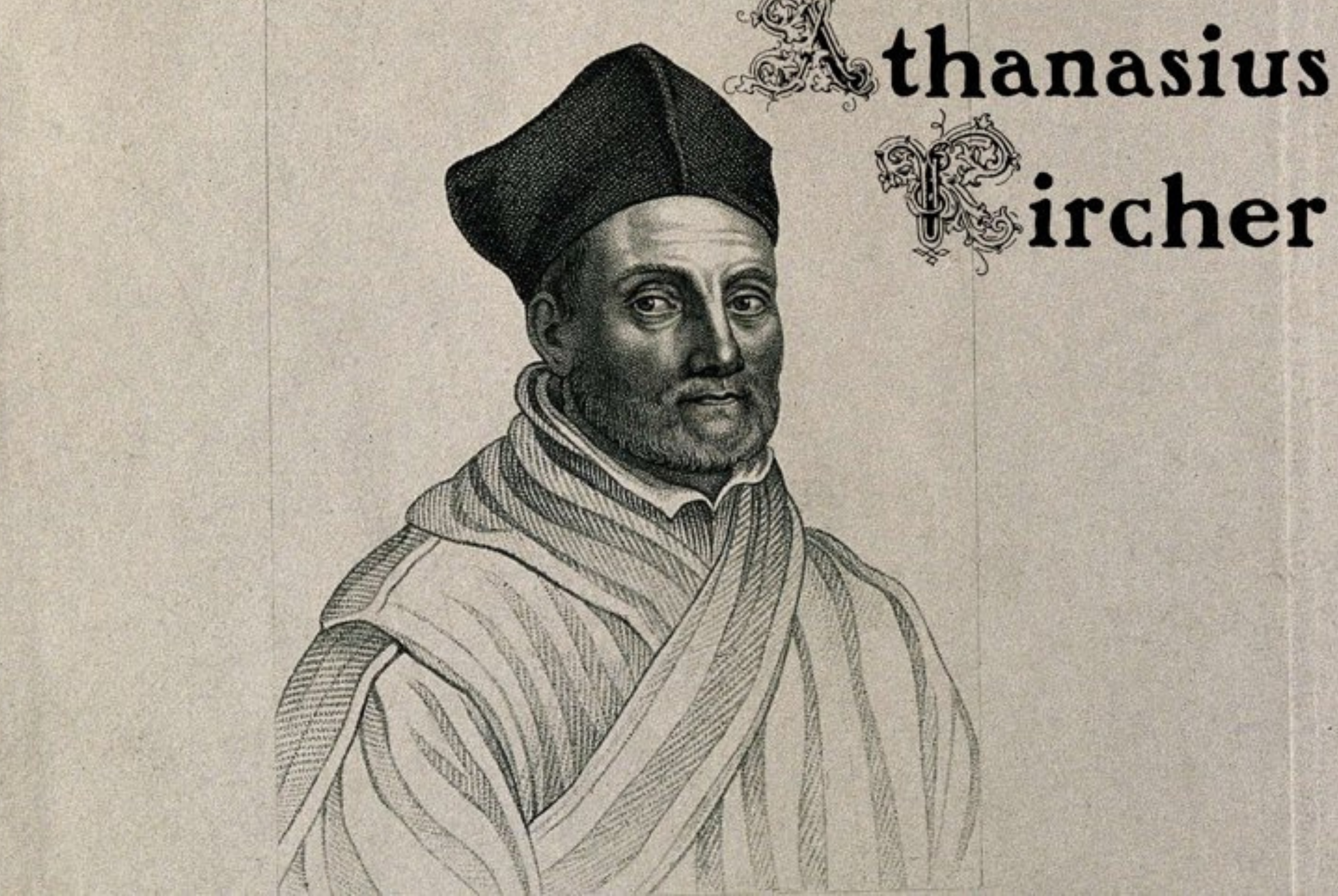
Throughout the centuries, the Society of Jesus has brought forth figures capable of leaving a deep mark not only on spiritual life, but also in the fields of science, culture, and scholarship. Among these figures, Athanasius Kircher stands as one of the most emblematic examples of this intellectual vocation: a Jesuit scholar who, in the seventeenth century, sought to embrace the entirety of human knowledge.
Athanasius Kircher was one of the leading representatives of seventeenth century encyclopedism. His interests ranged from philosophy to mathematics, from linguistics to optics, from music to the natural sciences, extending to collecting and the study of ancient civilizations. In a time when disciplines were not yet rigidly separated, Kircher embodied the idea of unified, interconnected knowledge, capable of interpreting the world as a vast system of relationships.
A brief biographical profile
Athanasius Kircher was born on May 2, 1602, in Geisa, Germany. His father, Johannes Kircher, had studied philosophy and theology, although he never pursued an ecclesiastical career. He entered the service of the prince abbot of Fulda, Balthasar. When the latter was expelled, the family lost its political and economic support and was forced to retreat to a simpler way of life.
From a young age, Athanasius showed a strong inclination toward study, particularly for classical languages, dedicating himself to Greek and Latin texts. At just sixteen, he entered the Society of Jesus, where he was able to deepen systematically the fields that interested him. After his novitiate, he devoted himself to the study of languages and sciences, distinguishing himself for his intellectual vitality and versatility. He began his academic career as a professor of philosophy, mathematics, and oriental languages in Würzburg, starting a path that would make him one of the most multifaceted minds of seventeenth century Europe.
He spent much of his life in Rome, where he worked at the Roman College, the main Jesuit university center. He died in 1680 at the age of 78. His heart is still preserved in the Sanctuary of the Madonna delle Grazie at Mentorella, one of the oldest Marian sites in Italy.
Between hieroglyphs and early Egyptology
Among the many disciplines to which he devoted himself, Kircher was one of the most renowned scholars of hieroglyphs of his time. Although many of his interpretations were later revised, his contribution remains significant. He was among the first to intuit the connection between ancient Egyptian and Coptic, the final stage of the Egyptian language, developed between the third and seventh centuries AD, thus opening the way to new studies of ancient Egypt.
His interest also extended to China. Kircher composed a vast encyclopedic work dedicated to this world, identifying for the first time the presence of Eastern Syriac Christian communities and seeking cultural and religious connections between East and West.
A global vision between science, imagination, and faith
During his lifetime, Athanasius was one of the most renowned scientific figures in Europe. Only in later years was his reputation gradually overshadowed by the rise of Cartesian rationalism, yet in the twentieth century his work was re evaluated for its symbolic, aesthetic, and visionary strength. The scholar Alan Cutler described him as “a giant among seventeenth century scholars” and “one of the last thinkers able to claim the whole of human knowledge as his domain.”
Based at the Roman College, Kircher became a point of reference for Jesuit missions and for the global circulation of knowledge. Thanks to the international network of the Society of Jesus, he received information, natural specimens, and scientific observations from Asia, America, and Africa, which were incorporated into more than forty encyclopedic works. As a culmination of this universal vision, he founded the Kircherian Museum, one of the earliest “cabinets of curiosities,” conceived to display the diversity of creation as an expression of divine greatness.
Science, symbol, and spirituality
For Kircher, scientific research was not in opposition to faith. On the contrary, the study of nature was a way to understand the work of God. In an era marked by the scientific revolution and the crisis of traditional certainties, he attempted to integrate new discoveries, Aristotelian philosophy, and hermetic symbolism into a unified vision of the world.
His work can be read as an example of science at the service of faith, in which observation, imagination, and spirituality converge toward a single aim: the contemplation of the complexity of creation
A legacy that still speaks today
Athanasius represents an emblematic figure of seventeenth century scholarship: a Jesuit in whom intellectual research and faith were in constant dialogue. For him, to know meant to connect, to explore, to gather, and to interpret reality in its complexity.
His story bears witness to how the Society of Jesus contributed not only to the spread of faith, but also to the construction of a global vision of knowledge, anticipating cultural and scientific dynamics that still influence the way we understand the world today.
Condividi