Roberto Bellarmino: Educating for Depth in a World of Immediate Answers
Knowledge Does Not Simply Mean Having Answers
We live in a time when finding an answer seems to have become incredibly easy. It takes only a few seconds to search for information, compare opinions, or ask an artificial intelligence. Increasingly, the real challenge is not gaining access to knowledge, but learning how to understand it, evaluate it, and place it within a broader context.
This is a profoundly educational challenge. Educating a person does not simply mean providing information, but helping them develop the tools needed to distinguish, explore, compare, and build informed and thoughtful perspectives.
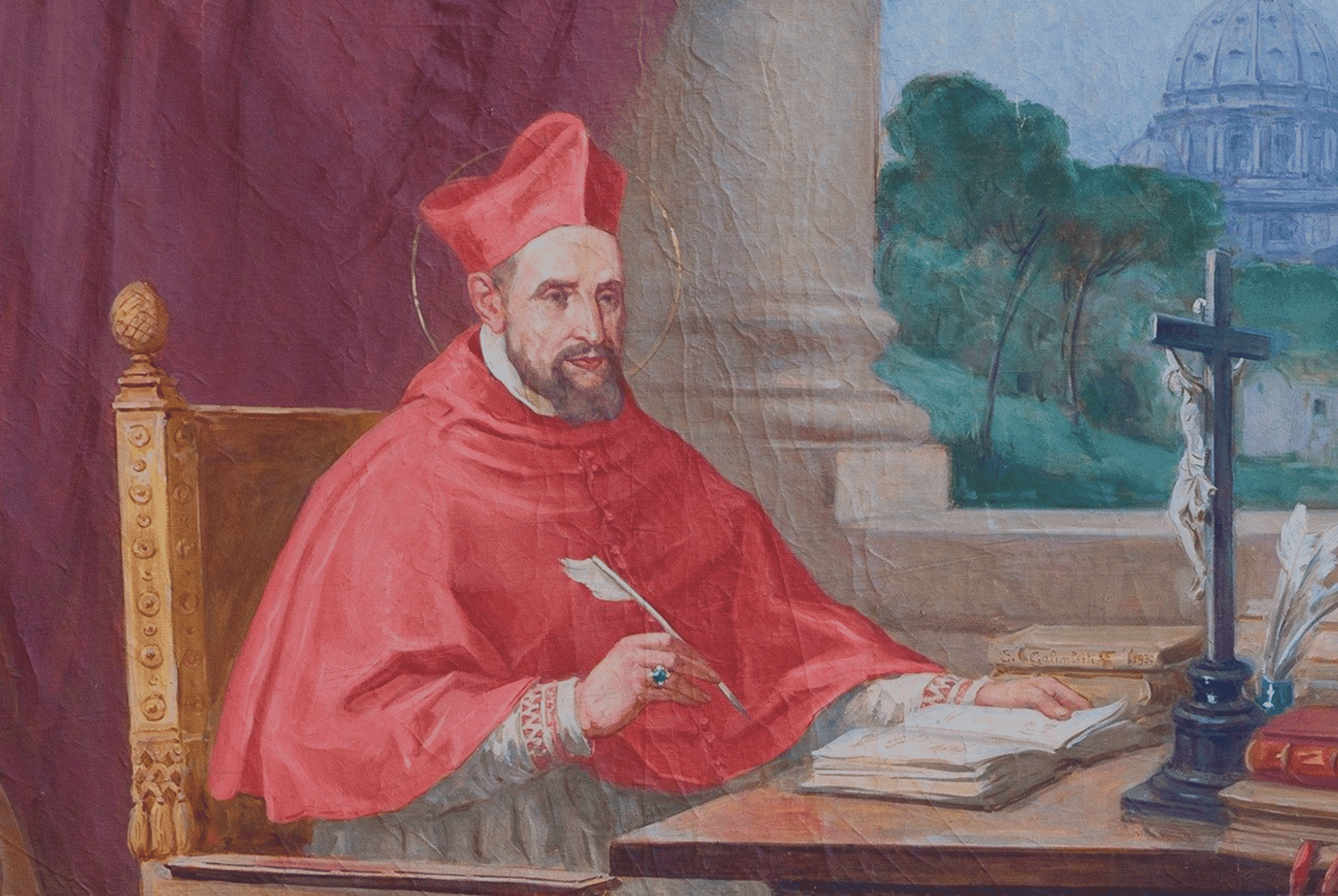
More than four centuries later, the figure of the Jesuit Roberto Bellarmino can offer an interesting perspective in precisely this direction. A theologian, professor, cardinal, and Doctor of the Church, Bellarmino devoted much of his life to study and teaching, living through one of the most culturally and religiously complex periods in European history.
A Jesuit Between Study and Teaching
Roberto Bellarmino was born in Montepulciano on 4 October 1542 and entered the Society of Jesus in 1560. His formation took place between the Roman College, Padua, and Leuven, where he deepened his studies in philosophy and theology. Ordained a priest in 1570, he taught theology in Leuven and was later called to Rome, where, from 1576 to 1586, he held the chair of theological controversies at the Roman College.
It was a period marked by the consequences of the Protestant Reformation and the Council of Trent, profound religious divisions, and intense intellectual debate. Bellarmino therefore found himself teaching and writing in a context in which understanding the different positions at stake and arguing clearly were concrete necessities.
The lectures he delivered at the Roman College were later collected in the renowned Controversiae, a work distinguished by the clarity and richness of its content, as well as by the historical attention with which it addressed the issues of its time.
It is precisely here that his experience can speak to a contemporary educational question: how can we learn to address complex issues without reducing them to simplistic answers?
Educating for Deeper Understanding
Immediate access to information does not necessarily correspond to a greater ability to understand.
Today, students and educators are confronted daily with an amount of content that would have been unimaginable only a few years ago. Social media, search engines, and artificial intelligence provide rapid access to information and different interpretations. In this context, one of the most important skills is the ability to pause, verify sources, recognize different perspectives, and develop one’s own judgment.
Bellarmino’s intellectual experience naturally belongs to a context very different from our own. Yet it recalls a principle that remains relevant today: when faced with complexity, the educational response cannot be superficiality.
Knowledge requires time. It means exploring questions in depth, understanding their context, and learning to articulate one’s own position. It also means accepting that not every question can immediately be given a simple answer.
Knowledge as Responsibility
In the educational tradition of the Society of Jesus, study is never simply an accumulation of knowledge. Intellectual formation acquires meaning when it helps people to understand reality and assume responsibility within it.
In Bellarmino’s life too, study and responsibility remained closely intertwined. Alongside his academic work, he served as spiritual director to Jesuit students at the Roman College—including Saint Aloysius Gonzaga—and later took on important responsibilities within the Church. Between 1597 and 1598, he also composed the Dottrina cristiana breve (Short Christian Doctrine), which was to become one of his most widely circulated works.
This aspect allows us to view his journey not only through the figure of the great theologian, but also through that of the educator: knowledge has value when it can be shared and become a tool at the service of others.
From this perspective, competence carries responsibility with it. The more deeply we understand reality, the more we are called to ask ourselves how we can use what we know.
Learning to Engage with Complexity
There is another aspect of Bellarmino’s life that can be particularly interesting today: the complexity of his story itself.
The Pontifical Gregorian University, of which Bellarmino is patron, emphasizes that he is not a figure who can easily be reduced to a simplistic interpretation. He played a leading role in the major theological, political, and intellectual controversies of his time, and some of his own positions were the subject of discussion and criticism. Even his Controversiae encountered opposition within the Catholic world.
Recognizing this complexity does not diminish the value of his figure. On the contrary, it allows us to approach him from a more interesting educational perspective.
Studying a person also means learning to place them within their own time, understand their choices, and engage critically with their legacy. This is a particularly important exercise today, when public debate frequently tends to divide people and ideas into immediate and opposing categories.
Educating for critical thinking means, instead, learning to engage with nuance.
From Knowledge to Discernment
Here Bellarmino’s experience meets one of the central elements of Ignatian pedagogy: discernment. Having access to a great deal of information does not automatically mean knowing how to choose. To find direction, we need to learn to observe, explore more deeply, connect what we know, and reflect on the consequences of our decisions.
Educating for depth, therefore, does not simply mean asking students to study more. It means helping them develop a way of looking at reality that goes beyond the first answer, verifies what they encounter, and recognizes complexity without being overwhelmed by it.
In an age marked by immediacy, this capacity becomes an important form of freedom.
An Educational Legacy for the Present
Roberto Bellarmino died in Rome on 17 September 1621. He was canonized by Pope Pius XI in 1930 and proclaimed a Doctor of the Church the following year. His legacy remains deeply connected to the intellectual and educational history of the Society of Jesus and the Roman College, from which today’s Pontifical Gregorian University originated.
Rediscovering his figure today does not mean looking to the past for ready-made answers to the present. Rather, it means recovering a question that continues to concern every educational experience: what does it really mean to know?
Reading Roberto Bellarmino today means encountering a figure who reminds us that knowledge requires time, rigour, and a willingness to engage in dialogue. Not everything can be reduced to an immediate answer, and not every complex issue can be approached through simple categories.
Perhaps this is precisely his most interesting legacy for the present: learning to stay with questions, to explore before judging, and to develop a way of thinking capable of bringing together competence and responsibility.
At a time when knowing often seems to mean having rapid access to information, Bellarmino invites us to rediscover another measure of knowledge: one that is not satisfied with knowing more, but seeks to understand better.
Share